

The era of blind reliance on historical data patterns has ended, as the catastrophic asset failures of the mid-2020s proved that traditional machine learning cannot predict what it hasn't seen before. You recognize that in mission-critical environments, the cost of a "black swan" event is not just financial; it's a fundamental threat to operational stability. This high-stakes comparison of Uptake vs OpEx360AI examines the evolution from legacy predictive models to autonomous platforms that leverage physics-grounded reasoning.
We promise a rigorous briefing on how to achieve zero unplanned downtime through superior architectural orchestration. You'll discover how OpEx360AI moves beyond simple anomaly detection to provide a unified operational view that bridges the gap between engineering expertise and executive-level results. We will evaluate how this system integrates seamlessly into legacy SCADA infrastructures to transform your facility into a self-correcting, autonomous environment.
Key Takeaways
- Distinguish between the statistical pattern recognition of legacy systems and the next-generation physics-grounded reasoning required for autonomous industrial operations.
- Conduct a high-stakes assessment of Uptake vs Nexora AI to align your technology investment with the specific complexity and risk profile of your mission-critical assets.
- Understand how specialized tools like NexoraPulseAI and NexoraShaftGuard deliver verified certainty in failure predictions by modeling the actual physical laws governing heavy machinery.
- Identify the strategic advantages of deploying NexoraAegisAI to move beyond simple monitoring into the comprehensive protection of vital infrastructure and civil defense systems.
The Evolution of Industrial Intelligence: Uptake vs Nexora AI
The industrial sector stands at a critical crossroads where the margin for operational error has effectively vanished. As we move through 2026, the conversation surrounding Uptake vs Nexora AI has shifted from the mere collection of data toward the sophistication of architectural reasoning. We are witnessing the definitive transition from Predictive Maintenance 1.0, which relied on statistical probability and historical pattern recognition, to version 2.0, an era of autonomous intelligence capable of real-time operational orchestration. This evolution marks the end of "black-box" AI models that offer correlations without causation, replacing them with systems that understand the fundamental physical reality of the assets they protect.
The Legacy of Predictive Analytics
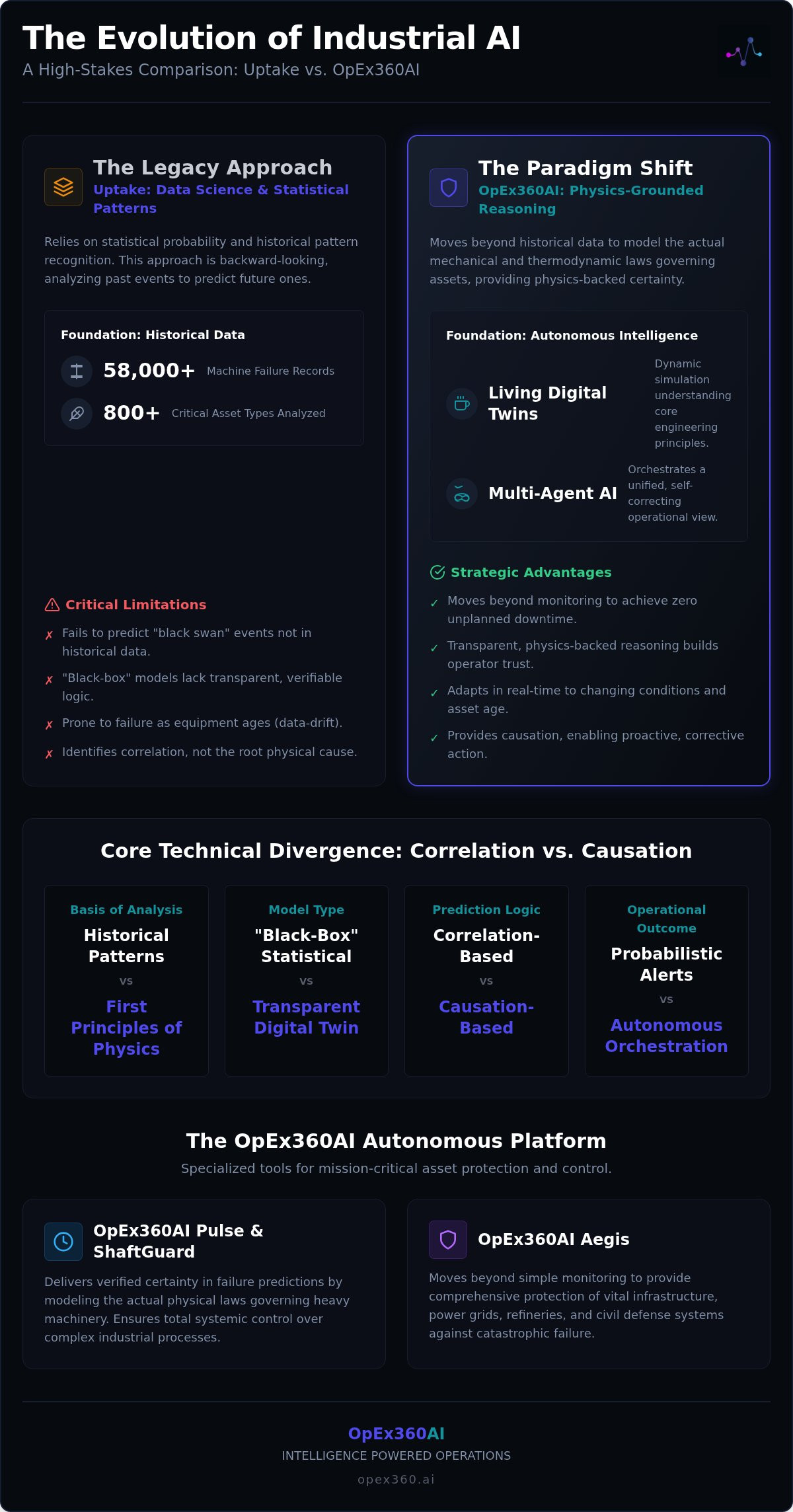
Uptake established itself as a formidable pioneer by leveraging a massive Asset Strategy Library that contains records of over 58,000 machine failures across more than 800 critical asset types. By applying large-scale predictive maintenance techniques, they successfully moved the industry away from reactive cycles toward a model based on historical data science. This approach has served many enterprises well, yet its limitations become apparent in high-stakes environments. Relying solely on "normal" operating history to predict rare failures is inherently backward-looking. Legacy platforms often struggle with the non-linear complexity of modern multi-stage industrial processes, as they cannot easily account for conditions that exist outside their training data. When an asset encounters a unique operational stressor not found in the historical record, a purely statistical model often fails to provide the necessary warning.
The Paradigm Shift to Autonomous Multi-Agent Intelligence
Nexora AI represents the strategic evolution required for the next decade of global infrastructure. Rather than simply scanning for anomalies in a dataset, Nexora Core AI functions as a unified data orchestration platform that utilizes autonomous multi-agent intelligence. This architecture allows for a "living digital twin" approach, where the AI doesn't just watch the data; it understands the engineering principles behind it. By bridging the gap between human engineering expertise and real-time execution, Nexora AI ensures that every failure prediction is grounded in physics-backed certainty. These autonomous agents navigate complex operational environments to provide a unified view, allowing executive leaders to move from reactive management to a state of total systemic control. In refineries and power plants where unplanned downtime is a catastrophic financial risk, this shift from probability to physical reasoning is the ultimate differentiator.
Data Science vs. Physics-Grounded Reasoning: The Technical Divergence
The fundamental divide in the Uptake vs Nexora AI debate lies in the distinction between correlation and causation. While Uptake relies on statistical machine learning to identify anomalies within massive datasets, Nexora AI utilizes physics-grounded reasoning to model the actual mechanical and thermodynamic laws governing industrial assets. This distinction is critical for executive leaders considering the strategic implications of industrial AI. Statistical models identify that something is wrong, but they often struggle to explain the underlying cause. Nexora AI provides that missing context by treating every machine not just as a data source, but as a physical entity subject to the laws of engineering.
The Problem with "Black-Box" ML in Heavy Industry
High-stakes operational environments demand more than just a probability score. Engineers frequently distrust "black-box" models because they can't verify the logic against first principles of physics. There's also the persistent risk of data-drift. As industrial equipment ages or environmental conditions shift, traditional ML models trained on "normal" historical data become obsolete. They begin to flag healthy operational shifts as failures or, worse, miss subtle degradation entirely. Nexora’s transparent reasoning builds trust by allowing operators to see the physical evidence supporting every alert. This transparency is vital when comparing the long-term reliability of Uptake vs Nexora AI in mission-critical sectors.
Orchestrating Living Digital Twins
True autonomy requires a transition from static monitoring to dynamic simulation. Nexora AI achieves this through Living Digital Twins that integrate real-time sensor fusion with rigid engineering constraints. This isn't a mere visual representation; it's a functional mathematical mirror of the plant’s performance. Nexora AI integrates physics-grounded reasoning to predict failures by calculating the underlying mechanical stresses and thermal limits before these issues ever manifest as detectable anomalies in sensor data.
Within this architecture, NexoraPulseAI serves as a specialized layer for real-time monitoring. By applying physics-based filters to incoming data, it effectively eliminates the false positives that plague standard analytics platforms. This precision ensures that your maintenance teams only respond to verified threats, preserving both human resources and capital. To see how these physics-backed models can stabilize your specific infrastructure, you can explore our autonomous suite. This level of certainty is what separates a visionary strategy from a high-risk gamble.
Feature Showdown: Nexora AI Suite vs. Uptake’s Analytics
Operational visibility is a baseline requirement, not a strategic advantage. While Uptake provides comprehensive dashboards and fleet-wide anomaly detection, the Nexora AI suite delivers specialized, high-precision tools designed for the intricate realities of heavy engineering. In the high-stakes evaluation of Uptake vs Nexora AI, the focus shifts from general data science to targeted architectural solutions that address specific mechanical vulnerabilities. You don't just need to know that a machine is vibrating; you need to know exactly why and how to rectify it autonomously before the system reaches a critical state.
Reliability and Precision Monitoring
Rotating machinery represents the heartbeat of industrial operations, where even a microscopic misalignment can escalate into a multi-million dollar failure. NexoraShaftGuard provides a level of precision that traditional vibration analysis simply cannot match. While legacy systems often flag high vibration levels only after damage has already begun, NexoraShaftGuard monitors real-time shaft alignment data to prevent the stress from occurring in the first place. This proactive stance is supported by NexoraPulseAI, which orchestrates asset health visibility across the entire enterprise. Ensuring these systems operate without error is a core focus of current research into Engineering Reliable Autonomous Systems, where the goal is absolute certainty in automated decision-making and mechanical assurance.
Vision-Based Intelligence and Safety
Safety protocols in high-risk environments have historically relied on human oversight and reactive SCADA alerts. This is no longer sufficient for 2026 standards. NexoraVisionAI transforms existing camera infrastructure into an intelligent safety guardian. Unlike standard monitoring, it utilizes real-time vision analytics to detect protocol breaches, unauthorized access, or subtle hardware degradation before an incident occurs. This system doesn't just watch; it verifies compliance and automates safety records, providing a level of auditability that human operators cannot provide. By augmenting human oversight with autonomous vision, Nexora AI ensures that safety is a constant, unyielding variable in your operational equation.
The ultimate leap in this technological evolution is the transition from "alerts" to "autonomous action." NexoraControlAI moves beyond the notification-heavy model of Uptake Analytics to take direct, controlled intervention. It bridges the final gap between detecting a problem and executing a solution, ensuring that your facility maintains optimal performance without requiring constant manual adjustment. This is the difference between a platform that reports on the past and one that actively secures your future through precise, autonomous orchestration.
Strategic Selection: Matching AI Architecture to Industrial Risk Profiles
Selecting the appropriate intelligence layer for your enterprise is a decision that hinges entirely on your specific risk profile. The choice between Uptake vs Nexora AI is not merely a technical preference; it's a strategic alignment of technology to the severity of failure. Uptake excels in environments characterized by high-volume, lower-complexity assets. If you manage vast fleets of transportation or logistics networks where historical failure patterns are abundant, their statistical models provide scalable visibility. However, mission-critical infrastructure demands a different architectural approach. Nexora AI is the definitive choice for high-stakes environments where even a single error is unacceptable.
In a petrochemical refinery, the financial impact of unplanned downtime can reach millions of dollars per hour. In these settings, generic machine learning is insufficient. You need the physics-grounded certainty of Nexora Core AI to maintain total systemic integrity. This architecture doesn't just predict; it verifies. It's the difference between a probabilistic guess and an engineering fact. For executive leaders, this transition from "likely" to "certain" is the only way to safeguard the balance sheet against the unpredictable nature of heavy industrial operations.
Risk Mitigation in High-Stakes Engineering
Assessing the cost of failure reveals a stark divide between industries. A delayed delivery in logistics is a manageable inconvenience; a cooling system failure in a power plant is a systemic catastrophe. Nexora’s multi-agent intelligence is vital for these complex, interconnected systems. It doesn't just monitor; it simulates. This capability is particularly evident in civil defense applications. AI agents use simulation to ensure fire safety compliance and operational readiness. This prepares your teams for emergency response before a crisis occurs, ensuring that fire pump intelligence and risk protocols are always active and verified.
Implementation and Legacy Integration
Successful AI deployment requires bridging the gap between legacy SCADA systems and modern autonomous orchestration. Nexora AI unifies disparate operational data into a single source of truth, eliminating the data silos that prevent a holistic view of the plant. By acting as a comprehensive industrial data orchestration platform, it ensures that your existing infrastructure becomes an active participant in your autonomous strategy. You can consult with our strategic experts to determine the optimal integration path for your facility. This ensures that your transition to autonomous operations is both seamless and secured against the limitations of aging hardware.
Beyond Monitoring: The Strategic Advantage of NexoraAegisAI
Industrial intelligence must extend beyond the machine to the entire operational ecosystem. While the comparison of Uptake vs Nexora AI often centers on asset health, NexoraAegisAI elevates the discussion to the protection of critical infrastructure. It serves as a sophisticated guardian for vital public and private assets. This specialized intelligence layer moves from simple monitoring to active defense, ensuring that the systems supporting global infrastructure remain resilient against both mechanical failure and systemic risk. It's no longer enough to watch for anomalies; you must orchestrate a total defensive posture that accounts for every operational variable.
Civil Defense and Critical Infrastructure
The protection of high-stakes environments requires specialized intelligence that generic platforms cannot provide. NexoraAegisAI offers dedicated solutions for civil defense, particularly in the management of fire pump systems and predictive safety modeling. In these scenarios, readiness isn't a suggestion; it's a requirement. By utilizing autonomous agents, the platform ensures that fire pumps are operational the exact second they're needed. This is achieved through continuous, AI-driven risk assessment and readiness simulations that prepare teams for emergency response long before a crisis manifests. These simulations don't just test the hardware; they verify the entire response chain.
- Automated verification of fire safety protocols and hardware status.
- Real-time modeling of emergency response scenarios to optimize deployment.
- Dynamic risk assessment for mission-critical civil infrastructure assets.
The ROI of Industrial Certainty
Quantifying the value of industrial intelligence requires looking at the total cost of catastrophic failure. For global industrial operations, regulatory compliance often represents a significant cost center that slows down execution. Nexora AI transforms this burden into a performance driver by automating the documentation and verification processes. This ensures that your facility remains compliant with international safety standards while simultaneously improving operational efficiency. The result is a state of industrial certainty that protects both human life and corporate capital. By integrating autonomous agents into your safety strategy, you eliminate the human error that leads to fines and operational shutdowns.
Choosing between Uptake vs Nexora AI ultimately depends on whether you seek a general analytics tool or a specialized architectural partner. For those managing mission-critical systems, the choice is clear. You can now Experience the future of industrial intelligence with Nexora AI and secure your operational legacy against the uncertainties of tomorrow.
Defining the Next Era of Industrial Sovereignty
The industrial landscape has reached a point where statistical probability is no longer a sufficient safeguard for mission-critical infrastructure. You've seen how the technical divergence between Uptake vs Nexora AI represents a fundamental choice between legacy pattern recognition and future-ready architectural reasoning. By prioritizing physics-grounded reasoning for asset failure, executive leaders can eliminate the uncertainty inherent in "black-box" models. The integration of autonomous multi-agent intelligence and living digital twin technology ensures that your facility doesn't just predict the future; it actively shapes it through precise, verified orchestration.
Securing your operational legacy requires a partner that understands the high-stakes reality of global infrastructure. Whether you're protecting complex refineries or vital civil defense systems, the transition to autonomous intelligence is the only path toward zero unplanned downtime and total systemic control. It's time to move beyond the limitations of standard monitoring and embrace a state of industrial certainty. We invite you to orchestrate your industrial future with Nexora AI. Your journey toward a resilient, self-correcting enterprise starts today.
Frequently Asked Questions
What is the primary difference between Uptake and Nexora AI?
The primary difference in the Uptake vs Nexora AI evaluation is the underlying intelligence architecture. Uptake utilizes statistical machine learning based on historical data patterns to identify anomalies. In contrast, Nexora AI employs physics-grounded reasoning to model the actual mechanical and thermodynamic laws of an asset. This allows Nexora to predict failures that have never occurred before, providing a level of certainty that simple pattern recognition cannot achieve.
How does physics-grounded reasoning improve predictive maintenance?
Physics-grounded reasoning improves reliability by calculating the physical stresses and thermal limits of machinery in real time. Unlike traditional models that only flag deviations from "normal" data, this approach identifies the causal root of degradation. It effectively eliminates false positives by verifying sensor data against engineering principles. This ensures that maintenance teams only intervene when a physical law is violated, preserving capital and human resources.
Can Nexora AI integrate with my existing SCADA and HMI systems?
Nexora AI is designed to integrate seamlessly with your existing SCADA and HMI systems without requiring hardware replacements. Nexora Core AI functions as a sophisticated orchestration layer that ingests data from disparate legacy sources. It unifies this information into a single source of truth, allowing for autonomous multi-agent intelligence to operate across your current infrastructure. This ensures a rapid deployment cycle while maintaining systemic continuity.
What industries benefit most from NexoraVisionAI?
Mission-critical sectors such as petrochemical refining, power generation, and heavy manufacturing benefit most from NexoraVisionAI. This system automates the monitoring of safety protocols and compliance records by analyzing real-time visual data. It augments human oversight in high-risk engineering environments, detecting protocol breaches or hardware degradation that sensors might miss. This provides an unyielding layer of protection for both personnel and vital assets.
Is Nexora AI suitable for civil defense applications?
Nexora AI is highly suitable for civil defense applications through the specialized NexoraAegisAI module. This platform provides critical infrastructure protection by modeling emergency response scenarios and ensuring the readiness of vital systems like fire pumps. Through AI-driven risk assessment and readiness simulations, it prepares civil defense teams for high-stakes events. It transforms safety from a reactive cost center into a proactive, verified performance driver.
How does NexoraShaftGuard prevent rotating machinery failure?
NexoraShaftGuard prevents failure by monitoring real-time shaft alignment data rather than just reacting to vibration levels. Most traditional systems only alert operators after damage has already started. NexoraShaftGuard identifies the microscopic misalignments that cause mechanical stress, allowing for corrective action before a catastrophic failure occurs. This precision is essential for maintaining the heartbeat of rotating machinery in power plants and refineries.
Does Nexora AI require a complete overhaul of my current data infrastructure?
You don't need a complete overhaul of your current data infrastructure to deploy Nexora AI. The platform is architected to bridge the gap between legacy silos and advanced autonomous intelligence. The choice between Uptake vs Nexora AI often hinges on implementation flexibility; Nexora Core AI unifies your existing operational data streams into a cohesive, living digital twin. This allows you to leverage your current technology investments while upgrading to a physics-backed operational model.
